I did my TapouT DVD last night and boy was it rough. It was a good workout, but I can tell that all that chocolate and candy from the holidays has made me sluggish. I was so worn out and I wasn't that worn out the first day I did Tapout!
That was my light bulb telling me to stop eating like crap and get back on the healthy eating bandwagon.

Showing posts with label fitness. Show all posts
Showing posts with label fitness. Show all posts
Saturday, December 28, 2013


Friday, December 27, 2013
TapouT XT -- Week 3
I've made it to week 3 of 12 in my TapouT XT videos. Today I have Cross Core Combat to do and I'm looking forward to it. I just wanted to give a little update to those who may be curious and kind of check in with updates relating to how I feel and what's going on with my "transformation."
Let me start by saying Happy Holidays to everyone and I hope everyone enjoyed the holiday of their choice. I personally celebrate Yule, or the Winter Solstice. My extended family, however, celebrates Christmas and so I end up celebrating that holiday with them. Anyway, for Christmas I received some very nice gifts. My mom got me a Keurig Vue coffee-maker. Of course, I don't drink coffee but it also brews tea and hot chocolate and I drink both of those! I also ended up receiving a healthy sum of money (in my opinion anyway) from my in-laws and I bought a juicer and a body analysis scale.
So! Updates! I put together the scale last night and Hubby and I played around with it some. I set up my Keurig and brewed a cup of sleepytime tea as well. I haven't had a chance to put together or set up the juicer yet but I bought a Breville juicer that I am really excited to try after watching all those documentaries on juicing and plant-based diets.
Onto TapouT XT updates. When I get home today I will be starting my 3rd week in the Tapout program and I must say I'm excited. I tried doing TapouT XT earlier this year (when I first bought the program), and I quit after feeling defeated by not enough time every day and going back to school at the same time. Well, this time I'm determined not to let school become an excuse not to exercise! While I do work full time, and I am in college full time, exercise needs to be a regular and routine part of my every day life --like eating or sleeping. I made straight A's this past semester while working full time, so I know I can exercise regularly and keep my grades up.
Anyway, doing Tapout this time around, I've noticed some differences. First, doing Tapout for just 2.5 weeks last time improved my strength tremendously; I can tell because this time around it actually seems easier. Tapout is still challenging and I can't keep up, but I've improved over the last time I tried it for sure. Mountain Biking is also helping and so is using the elliptical when I don't feel like doing an exceptionally hard Tapout video. Overall, I have been feeling healthier and I can tell when my bad habits surface because I tend to feel like crap.
Speaking of feeling like crap... I feel like crap! Because of the holidays, I've slacked on my healthy eating habits and I've let myself eat too much junk food (mostly chocolate but there's definitely some Pez candy in there too). I'm feeling sluggish and I even had the inkling of an anxiety attack around mid-morning today. I need to get back on the healthy eating because I can tell just how much it helps me feel better and healthier. I'm planning on getting out my juicer this evening and trying it out. Wish me luck!
Let me start by saying Happy Holidays to everyone and I hope everyone enjoyed the holiday of their choice. I personally celebrate Yule, or the Winter Solstice. My extended family, however, celebrates Christmas and so I end up celebrating that holiday with them. Anyway, for Christmas I received some very nice gifts. My mom got me a Keurig Vue coffee-maker. Of course, I don't drink coffee but it also brews tea and hot chocolate and I drink both of those! I also ended up receiving a healthy sum of money (in my opinion anyway) from my in-laws and I bought a juicer and a body analysis scale.
So! Updates! I put together the scale last night and Hubby and I played around with it some. I set up my Keurig and brewed a cup of sleepytime tea as well. I haven't had a chance to put together or set up the juicer yet but I bought a Breville juicer that I am really excited to try after watching all those documentaries on juicing and plant-based diets.
Onto TapouT XT updates. When I get home today I will be starting my 3rd week in the Tapout program and I must say I'm excited. I tried doing TapouT XT earlier this year (when I first bought the program), and I quit after feeling defeated by not enough time every day and going back to school at the same time. Well, this time I'm determined not to let school become an excuse not to exercise! While I do work full time, and I am in college full time, exercise needs to be a regular and routine part of my every day life --like eating or sleeping. I made straight A's this past semester while working full time, so I know I can exercise regularly and keep my grades up.
Anyway, doing Tapout this time around, I've noticed some differences. First, doing Tapout for just 2.5 weeks last time improved my strength tremendously; I can tell because this time around it actually seems easier. Tapout is still challenging and I can't keep up, but I've improved over the last time I tried it for sure. Mountain Biking is also helping and so is using the elliptical when I don't feel like doing an exceptionally hard Tapout video. Overall, I have been feeling healthier and I can tell when my bad habits surface because I tend to feel like crap.
Speaking of feeling like crap... I feel like crap! Because of the holidays, I've slacked on my healthy eating habits and I've let myself eat too much junk food (mostly chocolate but there's definitely some Pez candy in there too). I'm feeling sluggish and I even had the inkling of an anxiety attack around mid-morning today. I need to get back on the healthy eating because I can tell just how much it helps me feel better and healthier. I'm planning on getting out my juicer this evening and trying it out. Wish me luck!
Lean Body Mass, Muscle Mass, and Muscle Percentage
Ever wonder what all that fitness jargon means? Me too.
If you want to learn how to calculate your Lean Body Mass, click here. I wrote a post about calculating Lean Body Mass and your ideal weight a few days ago.
Now onto the question of muscle mass. It seems obvious that muscle mass is the amount of muscle present in your body, and that a muscle percentage statistic would show you the percentage of your body that muscle mass takes up. From all of the googling I've done, this seems to be the case, but when you pose the question of calculating these numbers, they don't tend to agree!
Let me explain. I just bought a body composition scale. In fact, I bought this one:

It's a Beurer Body Analysis Scale.
Anyway, some scales measure muscle mass and some scales measure muscle percentage. Mine measures muscle percentage. I have also used a scale that measures muscle mass. Here's where it can get confusing. I googled how to calculate muscle mass, and instead the few websites I found seemed to be giving me a formula for calculating lean body mass, which I already know how to calculate (see previous post). The formulas would use your body fat percentage and simply figure out what your supposed muscle mass is by subtracting your BF% from your total weight... but that leaves all the other stuff in your body in that number as well like bones, veins, and whatever else is in there. Then, somehow, I got a number that seemed close to what a previous scale had given me for muscle mass, but it seemed wrong too because if you took my body fat mass and my supposed muscle mass and added them together, there were only about 4 lbs left over to account for bones and stuff. I'm no expert, but I'm pretty sure that all the bones in my body probably weigh more than 4 lbs.
So I'm still lost, unfortunately. If anyone can explain to me how these scales measure muscle mass vs muscle percentage, that would be awesome. If it's exactly what it sounds like and the 2 scales that measured the 2 different statistics on me are just miles apart with regard to accuracy, I can understand that too.
I think that the closest I've gotten to a real muscle mass is actually by using the muscle percentage provided by the scale I own. This number seems to take into account my body fat percentage while also leaving out bones, blood and vessels, and non-muscle organs like skin. If my scale is reasonably correct, my muscle% is 29.4% or right around 51 lbs of muscle.
If you want to learn how to calculate your Lean Body Mass, click here. I wrote a post about calculating Lean Body Mass and your ideal weight a few days ago.
Now onto the question of muscle mass. It seems obvious that muscle mass is the amount of muscle present in your body, and that a muscle percentage statistic would show you the percentage of your body that muscle mass takes up. From all of the googling I've done, this seems to be the case, but when you pose the question of calculating these numbers, they don't tend to agree!
Let me explain. I just bought a body composition scale. In fact, I bought this one:

It's a Beurer Body Analysis Scale.
Anyway, some scales measure muscle mass and some scales measure muscle percentage. Mine measures muscle percentage. I have also used a scale that measures muscle mass. Here's where it can get confusing. I googled how to calculate muscle mass, and instead the few websites I found seemed to be giving me a formula for calculating lean body mass, which I already know how to calculate (see previous post). The formulas would use your body fat percentage and simply figure out what your supposed muscle mass is by subtracting your BF% from your total weight... but that leaves all the other stuff in your body in that number as well like bones, veins, and whatever else is in there. Then, somehow, I got a number that seemed close to what a previous scale had given me for muscle mass, but it seemed wrong too because if you took my body fat mass and my supposed muscle mass and added them together, there were only about 4 lbs left over to account for bones and stuff. I'm no expert, but I'm pretty sure that all the bones in my body probably weigh more than 4 lbs.
So I'm still lost, unfortunately. If anyone can explain to me how these scales measure muscle mass vs muscle percentage, that would be awesome. If it's exactly what it sounds like and the 2 scales that measured the 2 different statistics on me are just miles apart with regard to accuracy, I can understand that too.
I think that the closest I've gotten to a real muscle mass is actually by using the muscle percentage provided by the scale I own. This number seems to take into account my body fat percentage while also leaving out bones, blood and vessels, and non-muscle organs like skin. If my scale is reasonably correct, my muscle% is 29.4% or right around 51 lbs of muscle.
Saturday, December 21, 2013
Body Fat Percentage: Why Do I Care?
First, what is a body fat percentage? Your body fat percentage is literally the percentage of your body that is fat.
Why should you care about your body fat percentage? Well, first it can be eye-opening to know how much fat you are actually carrying around with you. Second, it can help you decipher other important numbers like your lean body mass and your ideal body weight. (For more information on LBM and how to find your ideal body weight, click here or here.)
So body fat percentage is important, but how do you figure out what yours is?
You can buy a scale that measures certain statistics about your body on top of measuring your current weight. These scales can measure things like your body fat percentage, your body water percentage, your muscle mass, your bone mass, and more. These kinds of scales can be costly, and you may also be able to find someone (a doctor, a nutritionist, a personal trainer, etc.) who may have a scale like this and can keep track of these numbers for you.

Another way to measure body fat percentage is by using a body fat caliper. These devices measure your body fat percentage by pinching areas of your skin and measuring the fat in that pinch of skin. This method can be very accurate, especially if the test is administered by a fitness professional who knows what he or she is doing, but it can also be limited to people whose BF% is below a certain level.

The last way I know of that is also affordable is to use a body fat monitor. The body fat monitors use the same method as the scales by running a small electric current through your body to measure the amount of fat, but they only measure body fat and they are much more affordable than a special scale. They look like this:

So how do you know what an ideal body fat percentage is? Well I've found a hand dandy chart for you!

Here's another way to look at it:

Women need more fat because our physical makeup is different than men. i.e. We have boobs and pop out children. So keep that in mind when figuring out your ideal body fat percentage.
Why should you care about your body fat percentage? Well, first it can be eye-opening to know how much fat you are actually carrying around with you. Second, it can help you decipher other important numbers like your lean body mass and your ideal body weight. (For more information on LBM and how to find your ideal body weight, click here or here.)
So body fat percentage is important, but how do you figure out what yours is?
You can buy a scale that measures certain statistics about your body on top of measuring your current weight. These scales can measure things like your body fat percentage, your body water percentage, your muscle mass, your bone mass, and more. These kinds of scales can be costly, and you may also be able to find someone (a doctor, a nutritionist, a personal trainer, etc.) who may have a scale like this and can keep track of these numbers for you.

Another way to measure body fat percentage is by using a body fat caliper. These devices measure your body fat percentage by pinching areas of your skin and measuring the fat in that pinch of skin. This method can be very accurate, especially if the test is administered by a fitness professional who knows what he or she is doing, but it can also be limited to people whose BF% is below a certain level.

The last way I know of that is also affordable is to use a body fat monitor. The body fat monitors use the same method as the scales by running a small electric current through your body to measure the amount of fat, but they only measure body fat and they are much more affordable than a special scale. They look like this:

So how do you know what an ideal body fat percentage is? Well I've found a hand dandy chart for you!
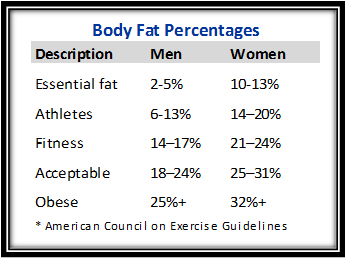
Here's another way to look at it:
Healthy Weight Loss and Your Ideal Weight
One of the first things a person thinks about after deciding that they want to lose weight is how much they want to lose, or what their goal weight should be, and many people don't know how to calculate that properly.
Personally, I just guessed. I asked my doctor what a healthy weight range for my height would be (between 125 and 155 lbs) and then just kind of picked an arbitrary number somewhere in the middle (140 lbs). My original method could work, but everyone is unique, even if you're the same height as someone else. Where another woman my height could easily maintain a healthy weight of 125 lbs, I think I would look sick if I lost that much weight. So how do we figure out what our ideal weight is?
Well, I've discovered a website: BuiltLean.com. Marc Perry has some great articles on his website that you can access even if you don't subscribe to his program. I found one on how to calculate your ideal weight. (source article)
So Marc Perry has a formula for calculating your ideal weight:
Personally, I just guessed. I asked my doctor what a healthy weight range for my height would be (between 125 and 155 lbs) and then just kind of picked an arbitrary number somewhere in the middle (140 lbs). My original method could work, but everyone is unique, even if you're the same height as someone else. Where another woman my height could easily maintain a healthy weight of 125 lbs, I think I would look sick if I lost that much weight. So how do we figure out what our ideal weight is?
Well, I've discovered a website: BuiltLean.com. Marc Perry has some great articles on his website that you can access even if you don't subscribe to his program. I found one on how to calculate your ideal weight. (source article)
So Marc Perry has a formula for calculating your ideal weight:
Lean Body Mass / (1 - your desired Body Fat Percentage in decimal form)
The formula in a simplified form looks like this:
LBM / (1 - your desired BF%)
Okay, I know what you're thinking. What the hell is Lean Body Mass?! Lean Body Mass is everything in your body (muscle, organs, bones, tissue, blood vessels, etc) except fat.
But how do you figure out that number? Here's how:
LBM = Your Current Body Weight - (Your Current Body Weight x Your Current Body Fat Percentage)
I know, I know, so many numbers! And how do you know what your body fat percentage is? Here's another number you need to know and keep track of.
You can figure out your body fat percentage a couple different ways. You can buy a scale that measures certain statistics about your body including your body fat percentage, your muscle mass, your bone mass, etc. These scales can range in price from just under $100 to over $400. I'm looking to purchase one that's about $220 after researching and reading tons of reviews. Another way you can measure your BF% is by using a caliper which is much cheaper to buy, although it can be difficult to use if your body fat is over a certain range. Currently, my BF% is higher than the range ideal for using a body fat caliper which is why I'm looking to buy a scale.
Anyway, back to the formulas! I have a number for my BF% because of my brief stint on Herbalife. The coach I spoke with had a fancy scale like the one I'm looking to buy and so I got a baseline for my stats. I want to give you an example so you can see how it all works with real numbers. I'll use my numbers.
First let's calculate my lean body mass. Remember, LBM = CW - (CW x CBF%)
My current weight is 176 lbs. The last time it was measured on the fancy scale with Herbalife, my BF% was 41.5%. We have to convert that percentage to a decimal, so my formula will look like this:
176 - (176 x 0.415) = 102.96 = LBM
So my lean body mass is ~103 lbs. Now to calculate my ideal body weight. Remember, Ideal Body Weight = LBM / (1 - your desired BF%). (For more information on your ideal body fat percentage, visit this link or this link.)
My Ideal Body Weight = 102.96 / (1 - 0.225) = 132.85
My ideal body weight is somewhere between 132 and 133 lbs. Because I know this is going to be a difficult goal to reach, my goal weight range is between 130 and 135 lbs. I'm giving myself some leeway. What's interesting is that I was ~130 lbs all through high school, and when I first got myself into shape in college, I weighed 135 lbs. It's nice to know that this weight range is realistic for me.
Juicing and Healthy Eating
Let's talk about juicing.
I very recently watched the following documentaries that are all related:


I very recently watched the following documentaries that are all related:
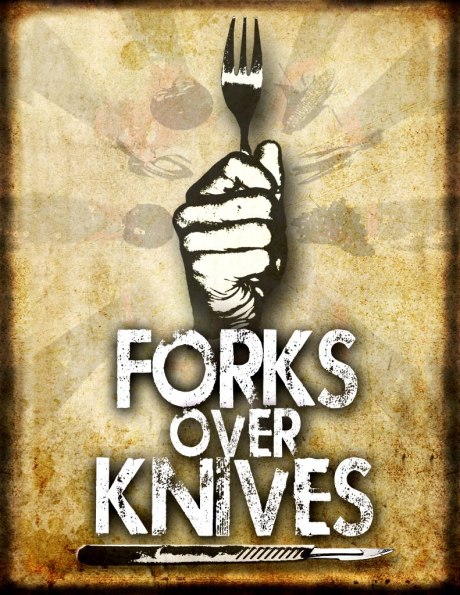
Forks Over Knives
Fat, Sick, and Nearly Dead

Food Matters

Hungry for Change

Many of the people, facts, ideas, and theories presented in these documentaries overlap between the 4 different shows. The first point all of these documentaries have in common is that people today as a whole are not eating enough plant-based whole foods. We're not eating enough vegetables!
The documentary I watched first, "Forks Over Knives," is very scientific in its approach. The 2 main people presented in the film are scientists who are also doctors. They separately came to the same conclusions using different research that complemented the other person's work independently. Both men in "Forks Over Knives" came to the conclusion that cancer and heart disease can be arrested and even reversed by eating a primarily plant-based diet and they have the scientific proof to show for it.
"Fat, Sick, and Nearly Dead" talks mostly about juicing as a way of detoxifying and cleansing a body that is "a cheeseburger away from a heart attack." At first glance, I thought this was a bit extreme, and it is. But what I really liked about this documentary is that both men who used juicing as an extreme detox method did it under the supervision of a physician, and the director of the film, Joe Cross, stresses the need to consult your doctor if you want to do a detox like the one he did and like the one the other guy did. The moral of the story? Don't just decide that you can do on your own what Joe Cross did under the supervision of a doctor.
I also want to mention here that the doctor Joe was supervised by is mentioned in relation to one of the doctors from "Forks Over Knives." Dr. Caldwell B. Esselstyn Jr.'s son, Rip Esselstyn, has his own campaign for the plant-based diet in his book The Engine 2 Diet. In The Engine 2 Diet, Rip Esselstyn mentions Dr. Joel Fuhrman, who supervised Joe Cross' 60-day juicing detoxification diet, as a source for research into the plant-based diet. It's also interesting to note that Rip Esselstyn also gives a mention to Dr. Dean Ornish in his book, and Dr. Ornish is mentioned in "Food Matters."
Both "Food Matters" and "Hungry for Change" mention juicing as well as the importance of an abundance of vegetables in a healthy diet. They also give mention to the anti-cancer benefits of eating clean and eating plant-based. The guy that directed "Fat, Sick, and Nearly Dead" makes an appearance
in "Hungry for Change." One of the guys from "Food Matters" also
appears in "Hungry for Change."
So what does all of this mean for me? Well it means that I want to change my overall diet and I want to begin to eat healthier. I am overweight by about 20 lbs. For my height, my doctor has informed me that a healthy weight is between 125 and 155 lbs. I currently weigh right around 175 lbs.
I love google and I love doing my own research, so I've been googling like crazy to get so much more information on how to tackle my health and weight loss goals. I've found a lot of helpful information, and I plan to share it here on my blog through a series of posts that I'm going to tag "healthy weight loss." Tune back in for more information as I do the research for you!
FitBit Update and Review
I decided to return the FitBit.
I wore the wristband religiously for a week and I noticed that it was giving me an output as if I'd climbed several flights of stairs per day when I hadn't climbed even 1 total flight of stairs. Although the steps were relatively accurate, the "active minutes" were not. The FitBit would record active minutes as I walked around at my job, but when I got home and I was performing my TapouT XT workout, it wouldn't record any active minutes even though I was jumping around, running in place, etc. My heart rat is highest while doing TapouT and yet no active minutes would be recorded on my FitBit; I'd have to add those minutes in manually.
Obviously, I'm not exactly sure how the FitBit records data. It doesn't seem to use heart rate as a factor because it can't give you a record of your heart rate. If the FitBit can in fact record a person's heart rate, the company is doing its consumers a disservice by not activating that capability as a function that can be tracked.
As far as the incorrect reading that I was climbing stairs when I wasn't, I can only imagine that my stride sometimes imitates the stride of a person climbing stairs, but I'm not sure how that might happen or how the FitBit would know that. So I returned the FitBit to Sports Authority for a full refund, and I can tell you my wallet is very happy to have that $137 back.
I wore the wristband religiously for a week and I noticed that it was giving me an output as if I'd climbed several flights of stairs per day when I hadn't climbed even 1 total flight of stairs. Although the steps were relatively accurate, the "active minutes" were not. The FitBit would record active minutes as I walked around at my job, but when I got home and I was performing my TapouT XT workout, it wouldn't record any active minutes even though I was jumping around, running in place, etc. My heart rat is highest while doing TapouT and yet no active minutes would be recorded on my FitBit; I'd have to add those minutes in manually.
Obviously, I'm not exactly sure how the FitBit records data. It doesn't seem to use heart rate as a factor because it can't give you a record of your heart rate. If the FitBit can in fact record a person's heart rate, the company is doing its consumers a disservice by not activating that capability as a function that can be tracked.
As far as the incorrect reading that I was climbing stairs when I wasn't, I can only imagine that my stride sometimes imitates the stride of a person climbing stairs, but I'm not sure how that might happen or how the FitBit would know that. So I returned the FitBit to Sports Authority for a full refund, and I can tell you my wallet is very happy to have that $137 back.
Wednesday, December 11, 2013
FitBit
Today I bought a FitBit Force. I'm excited to start tracking my fitness and sleep, so we'll see how this goes.
Hubby and I got a $250 giftcard to Sports Authority via #giftofsport and that's how I bought the FitBit. I'm still learning how to use it, but I figured out how to link it to MyFitnessPal. Now I just have to figure out how to get the 2 apps to share information.
I'm back doing TapouT XT and I think I might buy Insanity once I'm done with TapouT. I saw a 15 minute Insanity-style workout on YouTube with Dr. Oz and it looks interesting!
Anyone who is interested in friending me on FitBit, here is my public profile: http://www.fitbit.com/user/28SSJT
Interested in friending me on MyFitnessPal? Here's my profile for that site: http://www.myfitnesspal.com/ktherinerussell
--UPDATE-- December 21, 2013
Hubby and I got a $250 giftcard to Sports Authority via #giftofsport and that's how I bought the FitBit. I'm still learning how to use it, but I figured out how to link it to MyFitnessPal. Now I just have to figure out how to get the 2 apps to share information.
I'm back doing TapouT XT and I think I might buy Insanity once I'm done with TapouT. I saw a 15 minute Insanity-style workout on YouTube with Dr. Oz and it looks interesting!
Anyone who is interested in friending me on FitBit, here is my public profile: http://www.fitbit.com/user/28SSJT
Interested in friending me on MyFitnessPal? Here's my profile for that site: http://www.myfitnesspal.com/ktherinerussell
--UPDATE-- December 21, 2013
Friday, December 6, 2013
Back in BEAST MODE
After watching Forks Over Knives, I've decided that my diet and my fitness routine needs an overhaul.

I want to start eating cleaner and I'm going to attempt a (mostly) plant-based diet. Also, it's back to TapouT XT for me. I completed Day 1 today which was Cross Core Combat, and I felt like I did a lot better today than I did the very first day I got TapouT in the mail. Plus, I felt so pumped after I did it and I felt like a badass!

To celebrate, I had my hibachi leftovers for dinner. Yummy rice, broccoli, edamame, and filet mignon. Yes I know that filet mignon is animal protein, which is why I'm not completely cutting it out, but it was more of a side than a staple of the meal so it was good! Yay!

I want to start eating cleaner and I'm going to attempt a (mostly) plant-based diet. Also, it's back to TapouT XT for me. I completed Day 1 today which was Cross Core Combat, and I felt like I did a lot better today than I did the very first day I got TapouT in the mail. Plus, I felt so pumped after I did it and I felt like a badass!

To celebrate, I had my hibachi leftovers for dinner. Yummy rice, broccoli, edamame, and filet mignon. Yes I know that filet mignon is animal protein, which is why I'm not completely cutting it out, but it was more of a side than a staple of the meal so it was good! Yay!
Subscribe to:
Posts (Atom)